Sunday, April 14, 2019

Seeking a Shepherd

 Himayalan Ibex -- Skyin -- Capra sibirica

We are searching for someone who loves walking in mountains to carry the shepherd work through this summer in Tar village in Ladakh. This is something that people in the village consistently identify as a need, and specifically they approve of the idea of a friend or acquaintance of ours coming to fulfill this role for a time.

If you or someone you know would seriously consider it, living with folks here, eating wholesome food from this land, bringing bundles of wild fodder back all summer for winter storage, please be in touch with us. The best time to come would be before June so we can overlap with you, and we would need you to stay for at least two or three months.

village sheep in the yok ma (lower village)

Lots to learn, an amazing place to explore.  Homestays are available for less than the price of a hostel, with skillful and willing teachers in the crafts of the village.  If you come before June, we can get you started on language.  Plenty of flexibility to this job, but a serious commitment is needed, spending most days taking the herd from the village and tending them in the mountains and high pastures where they graze.  The village is at around 11,000 ft (3230 meters) elevation.

The slopes are steep and the footing is challenging.  The days are not terribly long, but it will take time for anyone's body to transition to this altitude.  Expect camping conditions and amenities -- the village is not on any road.  Living here is inexpensive compared to the US, and if expenses for the flight, passport, and visa are a limiting factor we can certainly find the needed funds among our networks.  India is newly offering a one-year e-visa which makes that process much faster and easier.

We're delighted at the idea of introducing someone new to our friends, these amazing people in the village. If you have a serious interest please comment here or find me as "Jason M Chandler" on facebook.

Please see the last two blog posts (Ice Melting and Returning) and the rest of the blog for more context and the reasons we make this ask.

Abi Yangchan Lhadzom, spinning sheep's wool

Saturday, April 13, 2019

Friday, April 12, 2019

Ice melting

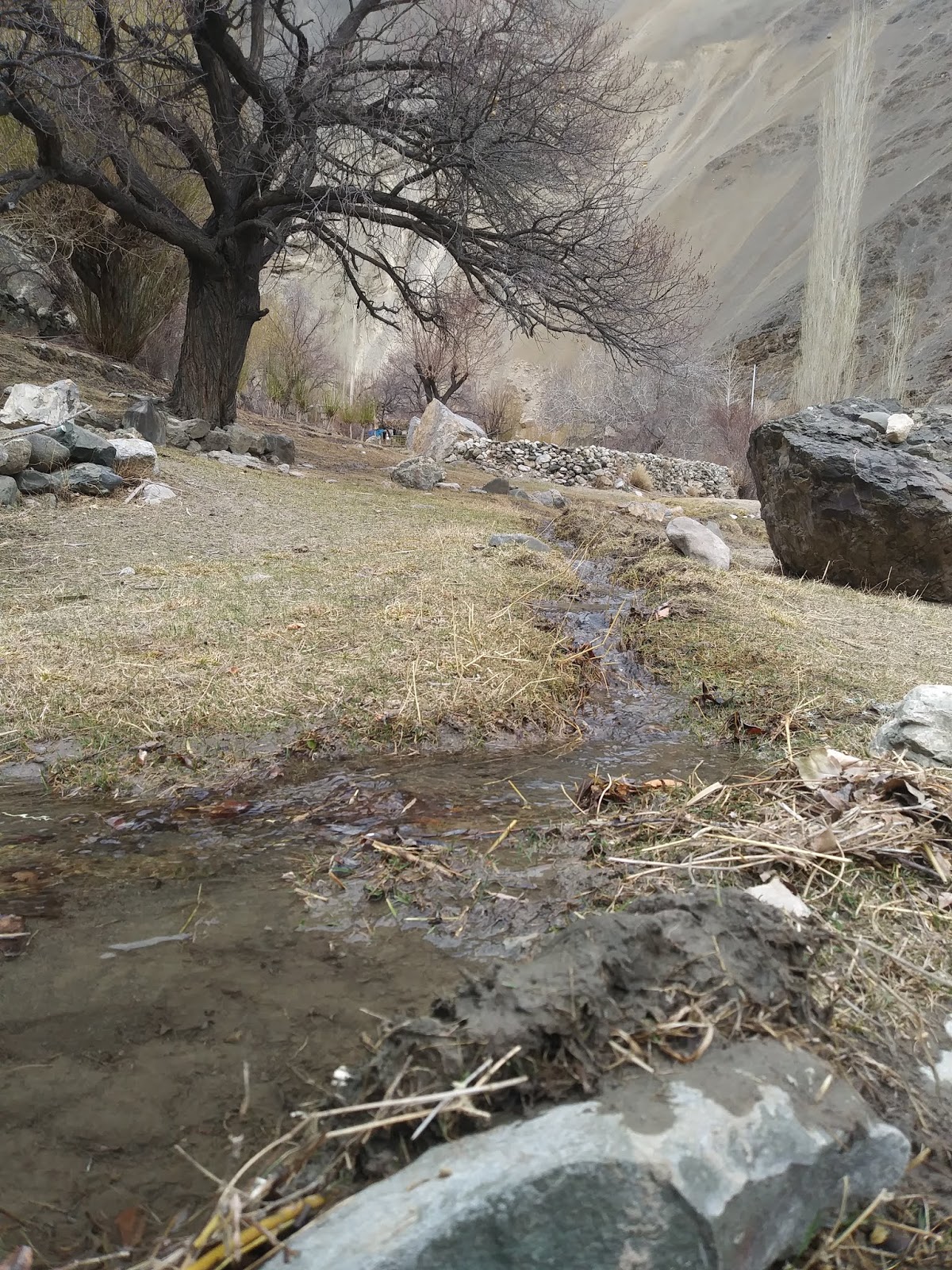
This past month was an ice-melting moon.  So much of the snow we saw everywhere is now dry rock as the first sliver of this spring moon waxes, and the stream has opened up a great deal, swelling with water.  This is the second clear evening we see this bright crescent, shining.

Manure work is almost done: another full day in the hot sun today, carrying baskets with people who know how to deal with their shit.

As I write, the last bare tip of the crescent slides behind a mountain that towers dark and purple to the southwest, where the ibex who were grazing near our work site today climbed high above us and disappeared into impossible cliffs.

The first stars are coming out between dark gnarled bud-rich branches of apricot.

~~~


There is a generation aging out in this village and they are still doing the majority of the everyday work to keep the animals well, the fields fertile, and the food flowing.  They have seen fifty, sixty, or seventy years.  They climb trees and save seed and plow fields and cut wood and carry water.  They know a great deal about how to live and how to work and enjoy life and do things simply and well.  And before mandatory education -- most of it in large institutions where children are beaten as punishment for unruliness -- teens were learning in their minds and bodies the ways to bring life to the village with their grandparents, in the fields, with the trees, around the hearth, and up in the valleys and shepherds' stone huts in the mountains.  There were great herds of sheep and goats up there each summer, herds that brought a renewing, abundant fertility to the old stone-terraced fields of barley, wheat, and peas in the village.  Now more and more of the village's elders are abandoning fields, lacking the labor and the animal manure to bring them through properly.

So, here's our position.  We know that the labor of just the two of us does a great deal to make these folks' lives and work more possible and more joyful.  And we know that the cultural interchange here with student groups and other guests has been rich and fruitful -- we've helped to facilitate this.  And in this time of returning to the village we feel our lives intertwined all the more with these people and this place.  We feel certain that we will return again, and we feel without a doubt that people want that, and want us to contribute to the life of Tar.  We know that we can contribute all the more if we bring friends with us when we return.


Should we now pursue a course of action in which Caitlin and I put significant energy into helping to bring visitors here to Tar?  The best kind would be those who will stay for months, do labor, learn language, potentially return in years to come, and thus not just take pictures of a place, not just go gather an experience for themselves, but actually help provide for the nourishment and revitalization of this place, and collectively do so in a long-lasting way.

With more labor and more people, more animals and more manure is possible -- healthy for the fields.  The Tarpa could afford once again to grow their herds of sheep and goats, bringing fiber and fertility.  With more homestay money flowing in, the village's young people would feel less pressure to leave the village to earn money, and with the draw of a steady multi-cultural presence in the village in the summertime, they would see more advantage in staying.  All our friends among the young people of Tar regret being away from the village so much -- this would give them another reason to stay.

What do you think?  Please respond in the comments below, and help us spread the word especially to young people that this type of opportunity is possible.  The likely start date is spring of 2021.

Photo by Mira van Dongen

Tuesday, February 26, 2019

Returning


Azhang Tundup is weaving his last chali on the roof.  The ten-inch-wide band of heavy white and black goat's wool is stretched horizontally in a twenty-foot-long loop that slowly rotates as you weave. When it's finished the narrow band of fabric will be cut to lengths and sewn together into a heavy over-blanket, like a wall against the cold. Many mornings a new layer of snow covers the weaving.  He just brushes it off and lets the Himalayan sun take care of it.

It took him two years with a herd of seventeen or eighteen goats to spin all of the wool for this chali; he sold most of them the spring we left, and then lost five to a pack of feral dogs from the army camp in Nurla. There won't be wool for another weaving, in his life.  His tall lean figure, walking the dry rocky valleys, comes to mind: whistling occasionally, goat's wool twisting in his fingers as the herd meanders up the stream.

Graciously he accepts our help and agrees to teach us, stretching the rgyu (the warp, forty long strands or so) in interlocking patterns, half of them at a time, first up, then down, hands passing the spuun-bo (shuttle) back and forth each time.  Checking the tension.  Repairing the strands that break with needle and thread.  The spuun-bo is a ten-inch length of finger-thick willow, split where it grips the ends of the three strands of goat's wool that will form the spuun (the weft, or back-and-forth weave).  These three strands are wrapped diagonally around and around the spuun-bo in a neat diamond pattern and slowly released before each pass through the tensioned rgyu.

The goats' wool is smooth but not so soft on the skin.  Finished the chali will be something like seven feet by five, but might weigh twenty pounds. When your host lays this over you in your winter bed, it can be hard to find the strength to come out from beneath it. 


A wooden device like a miniature sawhorse (a bung-bu, which means donkey) stands in front of the seated weaver.  A length of parachute cord looped twenty times around its cross-piece holds half the long strands up.  The other half sag for one pass, then cinching a board called a pari inserted beyond the bung-bu lifts the lower half up and the long strands interchange, the high above the low, for one pass.  Each time he switches, Azhang Tundup fluffs the strands with his fingers to help them separate, and slides between the two sets of strands a smooth gently-pointed piece of wood called a rayi, threading the gap.  Rayi also means sword.  The rayi is three inches wide and one inch thick, and once inserted he turns it vertical and it separates the sets of strands enough for the spuun-bo to pass through.  Then he turns the rayi back to horizontal and with both hands he rams its one flat edge towards his body, compressing the spuun and pulling the loop of weaving ever so slightly around.

We are so glad to be back in Tar.

Unexpectedly, this opportunity arose. A group of documentary filmmakers from South Korea wanted to make an hour-long television program about foreigners living in Ladakh. The chance came to return, and at the same time to reach many people with a view of the life of this place and our own lives and thoughts.  Every single day in Maine, we thought about the village and our friends here. They offered us our plane tickets to come back, and we said yes.

~~~

We finished the walk up to the village in the dusk of the day, made long by our sea-trained lungs. We stopped by the great boulder in front of Abi Dolkar's lower field, before reaching the first doorway; somehow it seemed right to sing first, before speaking. We took out the banjo and began to play Nilza Wangmo's song. Before the song was through Azhang Tundup had come, and Ache Tsering and Dechen Angmo, all laughing, holding our hands, pulling us to their homes for tea and food and sleep. Azhang Tundup walked off with the banjo, to make sure that we would come.

~~~

The next morning we were sitting in the sun with Dechen Angmo and Acho Rigzin, plucking wool from two sheep hides Rigzin had moistened and buried in manure four days before. He was preparing them to become the head of a snga, an upright ceremonial drumWhen they were clean we took them across the village to Meme Angchuk, to ask about the next steps. He told us they needed to be worked, a bit, and showed us the wooden frame he'd made. It took six days, he said: like the top eight inches of a barrel, with separate, slightly curved sections joined together into a round perhaps two and a half feet across and eight inches deep, carved and patterned. It stands on a staff four feet high, this one patterned by Rigzin, symmetrical around its form.

Finally Meme Angchuk decided that the hides were ready, and we pulled the first one taught over the face of the snga. This was only to see that it was big enough, and clear. We painted the frame edges with Fevicol (traditional?) and then replaced the hides, loosely, Meme Angchuk pressing down the center into a hollow. A ring around the edge received two strings, inside and out. When the snga was finished Meme Angchuk hung it by a nail in the ceiling to dry and it seemed like a great, wild spirit in the dim of the room, woolly edges of hide framing its blank and solemn face. The next day we saw that in fully drying the hides had stretched taut.  Beautiful.

~~~

We felt some nervousness about opening this window -- about agreeing to come in this way -- and so inviting them and their project to this high, quiet valley.  (Could this film bring tourists here?  In what ways would that be positive or negative?  What kind of relationship are we creating and what will that mean for the Tarpa?  Will these filmmakers have open hearts and be responsible and open to dialogue?)  And it turns out, in our view, that these filmmakers are sensitive, thoughtful artists who are moving with beautiful and penetrating questions.  They critically examine their own processes, thoughts, and ways of seeking stories.  They flew their drone and ran the run-down village generator each night to charge a plethora of batteries, and each day practiced a craft of placing cameras and framing shots and asking questions and delving into stories, hands always on the focus wheel to fine-tune each moment.

It was a new practice for us to be on camera, and to discuss with them and with the Tarpa by way of co-creating this documentary.  Bin, Moon, and Su also learned language, carved spoons from willow wood, and helped stretch a sheep hide for Abi Yangchan to help keep her knees and her back warm.  Through their questioning and with the help of Phuntsok Dorje (Markhapa) who acted as their guide and translator, we were able to have deeper and more nuanced conversations with people in the village, particularly about education and raising children, about traditional medicine, and about the practices of agriculture and how people here value themselves and their skills in these changing times.  Some of this will make it into the film, and we will share access to that when we know how.

A month later now, everyone in Tar knows three new people who care about the life of this place, and who will share a view of this place through their process of inquiry with a broad population in another nation about which we know only little.  We learned that almost all houses in Korea have radiant-floor heating, a very efficient method.  We learned that the US state has a lot of military personnel and weapons in South Korea, and that in the event of a war the President of the United States becomes the effective leader of the nation.  And on the Korean peninsula we learned that face-masks used to be needed occasionally, but for the last five years they are needed every day in order to be outside.  Every day.  Prevailing winds carry the smoke and airborne refuse from major Chinese manufacturing centers across the water straight through Korea.  I hope that all of us these days can make choices and good laws together so that in the future the air can be cleaner, especially for the children there.

We grew to love these new friends.  The visit and the filming are done for now, yet together we are weaving a longer term relationship.  If we are lucky we will see each other again, in Tar and in Maine.

The tv program will air in Korea (subtitled in Korean) this June.

~~~

We learned there is a medicine called dak zhun, "blood of the rock," that leaks from cliff cracks and hardens into black knobs that can be broken off, boiled and taken as a tea to help heal a host of ailments, including flesh wounds, knee and back problems, even broken ribs and bones.  There is a secret origin of this dak zhun.

~~~

Change is moving here.  The television is present in all our friends' households now, where three years ago there was only one.  Many people have smartphones, though there is not yet access to the internet.  In many villages the tractors and rototillers have replaced draught power. In Tar, fewer people in the village means they are able to care for fewer animals; lacking manure, the fields become poorer. In Leh, more and more young people are choosing their own partners, marrying for love. Languages flow into each other -- Ladakhi, English, Hindi, Urdu, Tibetan -- interpenetrating, shifting. The older people say that once they knew what would come in each season; now the weather is harder and harder to predict.

How will future years come to this place?  What are good ways to live here now?  What will be brought about by the complex set of decisions young people make in these decades of change?  What balances and harmonies can be sought between the long, ancient rock of skill and wisdom, and the quickly-flowing global-reaching education that is coming available?  We are asking these questions as we can, trying to learn.  And we find our steps walking a path both unexpected and familiar.

Monday, June 13, 2016

Leaving Tar

Photo by Lobzang Dadul
We left Tar as the apricot blossoms fell, lying in white shadows on the newly greening fields.  The last time we saw this we were more strangers in the village than family, not knowing yet what it would mean to give ourselves to the life of that place through the cycle of the seasons.  One year, and a little more: carrying manure, cleaning yura, preparing the fields to receive the water, plowing, giving the water, herding, planting gardens and alfalfa, weeding, harvesting, threshing, winnowing, cleaning and grinding grain, building a house, gathering earth for stable bedding, woodwork, then celebrating and teaching and resting and holding retreat through the long cold quiet of the winter.  Each day was its own distinct story of labor and hospitality, learning, the strength and exhaustion of the body, mountain-quiet.  A year is brief, especially in those fields, where histories stretch back more than a thousand years.  And yet it was long enough.  There was a whole life contained in those days.  The Tarpa saw us off with a feast of momo and many tears, laden with bags of chuli, pating, starga, tsigu, yos, and tiny rounds of tagi, gifts for our mothers in America.  (sour and sweet apricots, walnuts, apricot nuts, roasted wheat, and bread).

Now the work in Tar continues without us, though the need for help has not lessened.  It is hard, knowing this, and yet knowing also that our work is here in Maine.  It is time for us to start creating a place -- a farm, that grows into a school -- that strives towards the kind of community interdependence and ecological health that we found in Ladakh.

But if you are reading this, and find yourself longing to be of service in this high altitude desert, know that the way is open to you.  Some of our most rewarding times in Tar involved introducing visiting friends of ours to the people and the place, and all working and eating together.  The people of Tar assured us many times that in the future they would love to welcome you (our friends), and could really use your hands, your strong backs, your joy in exploring this mountain place, and your laughter.

If you go:

Please consider carefully the environmental cost of your plane flight.  (If you choose to take this one across the world, consider forgoing several others in the coming years?  Make one trip for several months rather than many for a week at a time?)  With lessening snowfall and shrinking glaciers, the farmers of Ladakh will feel the impact of a changing climate sooner and more directly than many people in the world.

Please consider buying a little yellow book called "Getting Started in Ladakhi" by Rebecca Norman (Becky), and learning as much language as you can.  I can't describe the difference that interacting through the medium of Ladakhi made in our experience and relationships.  You may also be able to meet Becky, a dear friend and an incredible help to us, at SECMOL (contact her before you visit, info at secmol.org).

And please, be in touch with us!  The best thing we feel we can continue to do for folks in Tar is to send our friends and keep building these relationships.  You can reach us by email at chandler.jm@gmail.com and/or cthurrell@gmail.com.  We would love to help you prepare and connect with folks there in a meaningful way.

Thanks for Reading
With Love,
Caitlin and Jason


Tuesday, May 10, 2016

Springtime Walk over the Ladakh Range

Photo by Stanzin Norboo

The sun blows a steady cold wind down from high passes this morning.  The people burn dung, a little willow, build stone upon stone, and wires are strung far across the gorge.  Steep sliding sides, pigeons in new-ploughed fields, tea and chang at the start and end of Domkhar Gongma.

We walk up from apricot country, Barma, old white stones of stream bed shining in clear sun, smoothed to giant eggs by time, uncounted.  Their dark specks glisten in a crushed-rock water channel.

Questions about Lhargyap, stories of wives young gone over the pass: a day to the high pasture, another day to the town, so they say.  The old link lives, tough to travel: expect snow and crevasses.  Sun set was long, catching halos aflame around rough-cheeked shepherds -- young ones too -- with an unruly herd at a knoll-top earth house, high valley opening to the west.

A planned 'calm' in Syria, hospital destroyed in Aleppo, sharp critiques and satire of American empire on Russian, French, German news.  Snow peaks glow red, then pink.  Stanzin Norbu (Shara) speaks of a rescue, white out in Zanskar in August, looking for a crevasse-fallen lone Frenchman who cut stairs with his swiss army knife and made it out.  We speak of a farm and school to be, of plans, canoes and rivers, and the possibility of a many-month journey by foot all over Ladakh, criss-crossing the ranges.  Domkhar valley is long, the valley of the palace on a rock.

-----

Paba thukpa (boiled bread and greens soup), intense eyes of an ama, a young bride from Changtang, and stories and directions today on the way to Lhargyap, which just means 'across the pass.'  Tharu, the village is also called.  An azhang pushing a rbat (wooden rake) -- "Don't go!" he and his wife say. "Can't do it.  No oxygen! Lots of snow!"  They've never made the crossing themselves, but the man went most of the way to the pass with a tourist group, one time.  Shara repeats the directions, again and again, drawing in the dirt.

Hiking along the stream, valley grows wide at the sumdo -- meeting of three high valleys.  Turtuk up a big valley left, to the northwest.  Angling right, but crossing to the bank to our left to escape gullies full of drifts of windblown snow.  We hear ribja (Tibetan snowcock), companions for all journeys in these high places.  Meet a grandfather, Shara's friend's brother, and he offers helpful words, guidance.  He has 70 in the herd, mostly goats.  He makes blankets in the winter time.

We are at the first pulu (high pasture summer settlement) and we curl up in a dry short-grass hollow of walls.  We found wood at the second shepherd's hut (which has wooden beams bridged by flat slabs of stone supporting the earth roof), and we stay at the third.  A few songbirds appear, one like a grackel.  Hopping along the snow surface on twiggy legs.  We fell through, socks and shoes wet as we crossed to the dry side.  There is a tale of 150 mountain goats seen all together in these valleys.

-----

A high gentle ridgeline eases into view, its face a shining smooth white-blue belly of snow.  Shadow of a tall man, shoulders furry, walking stick pumping up and down every two steps, leading my way.  Rhythm and vast mountains, a whole world of snow and slopes.

A scramble up boulders and through pits of deep snow; weasel and fox paths crossing ours, or perhaps the small one is a zebra (a pika or mouse-hare).  A phia (marmot) sends out several streams of whistle-squeaks, listening in between, as we approach up the flat ice of the valley floor -- calling in warning to others, no doubt.  He sits on all fours, then stands up straight, then down, up, and slowly into the hole, small tail flips.  We saw his tracks in mud yesterday, metacarpal pad, four toes outstretched in front (like an otter print but toes more forward), claws showing clearly.

A lone white-winged redstart perched in the middle of a snowfield today, watching, then flitting and flying off in the hot sun.

-----

Night of confusion and restlessness -- barely slept.  Where is the pass?

Shara's boots are soaked and frozen solid.  Finally, too late, the topo maps surface on a smart phone, with no battery left to examine them.

We head west in shining sun and snow, a full pot of maple butter sngampe porridge in my belly.  Shara doesn't eat.  I worry.  But we are high now, closer to Tharu than Domkhar, and the weather is crystal clear.

Over a false pass, a second, and up far up a third, I kick steps.  Pole plant, first, second, wait.  Again.  The dance of climbing the Ladakh Range.  A meditation.  Mara taunting at every turn of the mind.  And a steady being, in place, with each crunching step, pressed into the mountain.

We eat butter and bread we have saved.  Still three healthy days of sngampe in the packbasket.  We can camp on this snow.  We have kerosene.  The final push, but the other side of the heights we reach is a huge cornice and below, impossible cliffs.  Not the pass.

The pass we see below.  Back near our campsite.  Along ridgeline then, slow hours baking and windswept, and down a boundless snow slope, ropes tied around waists, zigzag of soft north face.  Down and across a new valley to camp, in the hollow melted out by a huge boulder, and under its roof, sun setting behind that same sharp corniced ridge atop which we stood.

And from the top: a world of icy peaks, kang ri, melting valleys of Nubra winking around corners, above the valleys and the great Nubra river beyond and the mountains rising beyond that are the Sa Ser peaks of Karakorum, heights of the crumpled and uplifted Asian tectonic plate.  The other way, south, lies the Sham Range and, beyond that, the shining mountains of Zanskar, with Nun and Kun at over 7000 meters towering, their great flat face impossible to fathom, coming into shadow as the sun begins its descent.  Looking down, we are head and shoulders above even that high world of snow valleys below.  Banks of cloud rest away east over Changtang, and a few Gangetic Plain thunderheads spew up, far off.

Photo by Stanzin Norboo


-----

Ridgeline fear, sheer drops.  Ice axe, heavy rope.  Shara looks over the cornice edge.  "Just catch me," he says.  Yesterday's visions swim.  It was another cold night but less sleepless.

This walk through a high snow world feels cleansing.  Far from the soft earth of fields.  The superfluous cast aside, or dropping away, unnoticed, on a packed valley of snow.

We melted ice chunks for water and packed the full bottles with my body for the night.  Burned rice and dahl -- too much, we toss it.

Today a descent across rolling packed snow meadows, down sliding the debris of kharut: snow floods.  Balls and sculptures of ice stand on immaculate surfaces, partly melted away into weird shapes by sun, trails sweeping up and around contours to deep rock clefts above.  This was a glacial pond that burst -- how many times?  Its gates are of rubble and soil, great mounds on which lean low walls of snow and ice.

Pass the valley wide on the right, see a high shoulder (does that way lead to Teya? back over passes to the long, straight valley cut down to the Indus?)  Turn the corner, and the guardians of the descent to Nubra arise one a mosaic of hard rock sharp teeth, the other unfathomable, both towering.  We could see the heights of this second kang ri even from our under-boulder camp, an intricate sculpture of orange rock and snow we first glimpsed in one fullness from above.

As we pass, its hidden steps reveal masses of ice, blue cliffs upon cliffs, ready to spill, one sharp snow-tooth above and beyond it all.  An answering ice mountain, its wave high and serene, completes the symmetry.  Under all this ice and snow is wet soil that will bear plants come June.  Two, three doksa (shepherd's huts) and we halt on a spang meadow, thousands of ice steps behind.  There is a house, round stones all tucked in corners, mortared inside, with great slabs beautifully set for shelves, caked with soot, plants hanging from the ceiling with leaves that catch my eye like sooty dried red peppers.  The house is simple and beautifully crafted.  Shara says: 'Looks like the ancients made it.'

-----

Down, down, ice and rock.  Glacier upon glacier towering to each side.  Kang ri means the mountain, and it means the ice.  They are not separate, on the Ladakhi tongue.  Clear clear waters tumble through tight passages, where vast horizontal moiraine cones lay far into the valley, their ends cut and carried and tossed in piles of shining white, gray-blue, and rust-red.  Ice thins in spots, two feet thick next to open water, and steep now, snowy surface crunching underfoot.

A path ascends the right-hand wall of the valley above cliffs, its stones pried into place and leveled by hand, now beginning to fall apart.  There, from a perch, we see two hundred yaks, all spread amongst the fields of the village, Tharu Gongma, in the lee of whose shepherd huts we slept through the night, awaking to grey skies giving way to first drenching rays of sun, and a phantom pyramid peak huge and clear, that vanished as the light rose.

Soon we are sitting inside earth-brick walls by the hearth with an energetic, beautiful old woman with reddened, almost tearful eyes.  She praises the boldness of our crossing and refills our cups with butter tea, then a strong and tangy chang.  The yulpa (villagers) were surprised to see us.

Shara employs a strategy with which I fully concur: talk with everyone you can in these high, pass-access villages.  Learn about them, their families, children and schools, farming and herding practices, and the ways they have passed over the mountains.  It's a way to come to know them, and their place, which provides everything.

No phones here, as we try to send word to our homes that we are safely in Nubra.  A rockslide-blocked jeep road and a stranded Tata pickup are the only connection of this twenty-household village to the outside, that and legs.

As the sun sneaks behind a high dry west ridge two villages down in Patsathang later that day, we meet two small groups of boys and young men, on their way up the two hour walk to their homes, returning from school and work for the ploughing.  Piles of manure on the fields in Tharu, and the tiniest yaks I've ever seen, balls of soft black hair lying curled up in morning sun.  Their phu (high pasture) is melting out, and it will be some weeks yet before it truly greens.

-----

Start date April 29, 2016
Day 1: Domkhar Barma (middle village) ~3700m to Porotsepa household in Kurambek village at 4150m
Day 2: to Kurambek Doksa, 4700m
Day 3: to Camp 1, 5126m, on snow
Day 4: over peak 5747m and over pass to Camp 2, 5290m, on snow under the boulder
Day 5: to Tharu Gongma Doksa, 4550m, off snow
Day 6: to Patsathang, 3611m

I realized on the trip that every piece of clothing I wore is wool.  Down sleeping bag, wool blanket, pack basket.  Three season tent.  Sheep pelt vest/sleeping mat.  Topographic maps and a 'GPS essentials' smart phone app for altitude and mapping.  Lots of talking with villagers and advice about the route beforehand.  An understanding that we may return in failure.  Two stoves, one kerosene, the other a wood-burning homemade rocket stove made from a Chinese thermos shell.  The weather was highly favorable.

Saturday, January 30, 2016

Melting Ice and Black Carbon

Photo by Lobzang Dadul


The greatest noticeable effects of global climate change in the Ladakh Himalaya these days are the shrinking of the glaciers and the increasing volatility of the weather.  This volatility we experienced this year in Tar village as below-average snowfall in winter and freak rains during the summer.  These rains would by no means have been unusual in Maine or many other places, but here the houses’ walls and roofs are made of earth, and when it rains they fall apart.  Also, flooding is a serious issue in this high desert landscape that has washed away houses, trees, water-powered grain mills, and even people in recent years.  The Tarpas (“people of Tar”) tell us they never had tarps for their roofs (which must be dumped by hand) until a decade or two ago, and they never needed them.  During a summer like this one, that is hard to imagine.  Without them (sometimes even with them), the earth roof leaks through onto everything and everyone in the rooms inside.

The clear general trend of glaciers throughout the Himalaya is that they are shrinking in area and losing mass in the Karakoram, in Ladakh, in Tibet, Nepal, and Bhutan.  That means they will produce less melt water in the future, if they aren’t already.  The many rivers with important dry-season sources in the Himalaya help support between 1.3 and 2.5 billion people.  For farmers in Ladakh, an additional challenge beyond having less water is that the melt water comes earlier, often too early for the planting, and slacks off while the crops still need weekly watering.  Here, no one counts on rain.  “The air temperature increase varies in different parts of the vast Himalayan region, but in almost every area the rate of warming is dramatically higher than the worldwide average.  Over the northwest Indian Himalaya, for example, temperatures have risen by 1.6 degrees C over the past century.” (Jonathon Mingle, Fire and Ice

I’ve just finished reading a book called Fire and Ice by Jonathon Mingle, a fellow from Vermont who has travelled through this region quite a bit as a teacher and writer and aid worker.  The book chronicles changes in a Ladakhi village in Zanskar.  It is mostly about climate change and in particular about something called “black carbon”.

Black carbon is what it sounds like – unburned organic carbon that escapes an inefficient fire as minute floating particles and becomes part of soot and smog.  There are other airborne products of inefficient fires such as brown carbon and other aerosols, but black carbon causes the most warming of them all, mostly because it turns so much of the sun’s light into heat.  It is widely agreed by scientists to be the second most important global climate forcer after carbon dioxide, and it is a much different and faster-acting agent of warming for three reasons.  One, it absorbs sunlight and warms the air directly around it immediately, as does the great cloud of smog that hangs over the Gangetic Plain of northern India, especially in winter with the increased use of biomass heating and cooking fires.  Two, it blows onto glaciers and ice sheets (locally and at greater distances) and reduces the ice’s reflectivity – the ice sheet becomes visibly dirty and melts much faster than it would have otherwise.  Much of Greenland’s ice sheet is suffering from this today.  So are the Arctic and the Himalayas.  And three, even if airborne black carbon isn’t immediately deposited near to its source, it only lasts about one or two weeks in the atmosphere.
The four major sources of black carbon are diesel engines, coal, open burning of biomass (agricultural waste, forest fires), and cooking/heating fires in simple stoves fuelled by wood, dung, waste, and coal.

About three billion people are still cooking and heating using inefficient stoves that smoke up their houses and their lungs, causing more than four million premature deaths in 2010, from pneumonia, lung cancer, cardiovascular disease, and chronic obstructive pulmonary disease.  This is a really major health issue that gets little attention in our world, which is wealthy enough to do something about it.  These stoves also constitute a major source of black carbon.  

So Mingle recommends diesel particulate filters on vehicles, improved efficiency coal-fired brick kilns, funnelling agricultural waste into efficient energy production, and replacing half a billion smoky stoves with efficient, clean-burning ones.  He makes a compelling case for the benefits of targeting and reducing these sources of black carbon right now (while acting also to reduce greenhouse gases), thus reaping immediate benefits.  He paints the picture that targeting black carbon in a major way right now could buy us time over the next couple of decades to get our carbon emissions in order.  Scientists have likened reduction of black carbon emissions as an “emergency brake” for humanity because we produce lots every day right now, to stop doing so is fully within our technological capacity, and black carbon’s warming is significant and occurs mostly within a very short window of time (whereas carbon dioxide warms the earth for hundreds to thousands of years).

---

At SECMOL we have an hour of English Conversation Class every evening, and once this month we decided to discuss climate change.  Water is at the center of the challenges from climate change that Ladakhis face these days.  The students in one group asked me, piecing it together in English: “Why must we face these problems when they have been caused by people in other far away countries?”  That’s a tough one to answer.  I asked in response: “Do you think people in my country, who became wealthy by burning these fuels, have a responsibility to help people in your country, who did not burn the fuels but still face these problems?”  I expected: “Yes!”  Instead, a bright, mischievous, creative sixteen-year-old man spoke these words: “They can help if they want.  We are satisfied…When we build a new yuracanal, we can put the stone there, and it’s okay.”

I had opened the class by telling the students and volunteers a bit about black carbon, but first I posed a basic question – “What causes climate change?” We received an unexpected, prescient answer that stopped me in my tracks.  Do Americans tend to lack this clarity of thought?  One young man raised his hand and earnestly responded: “Human desire.”